
AI Marketing Playbook #004: Build a Campaign Brief Like a Senior Performance Marketer
Use AI to build, structure or pressure-test a marketing campaign brief. Surface missing decisions, separate evidence from assumption, and align the whole team.
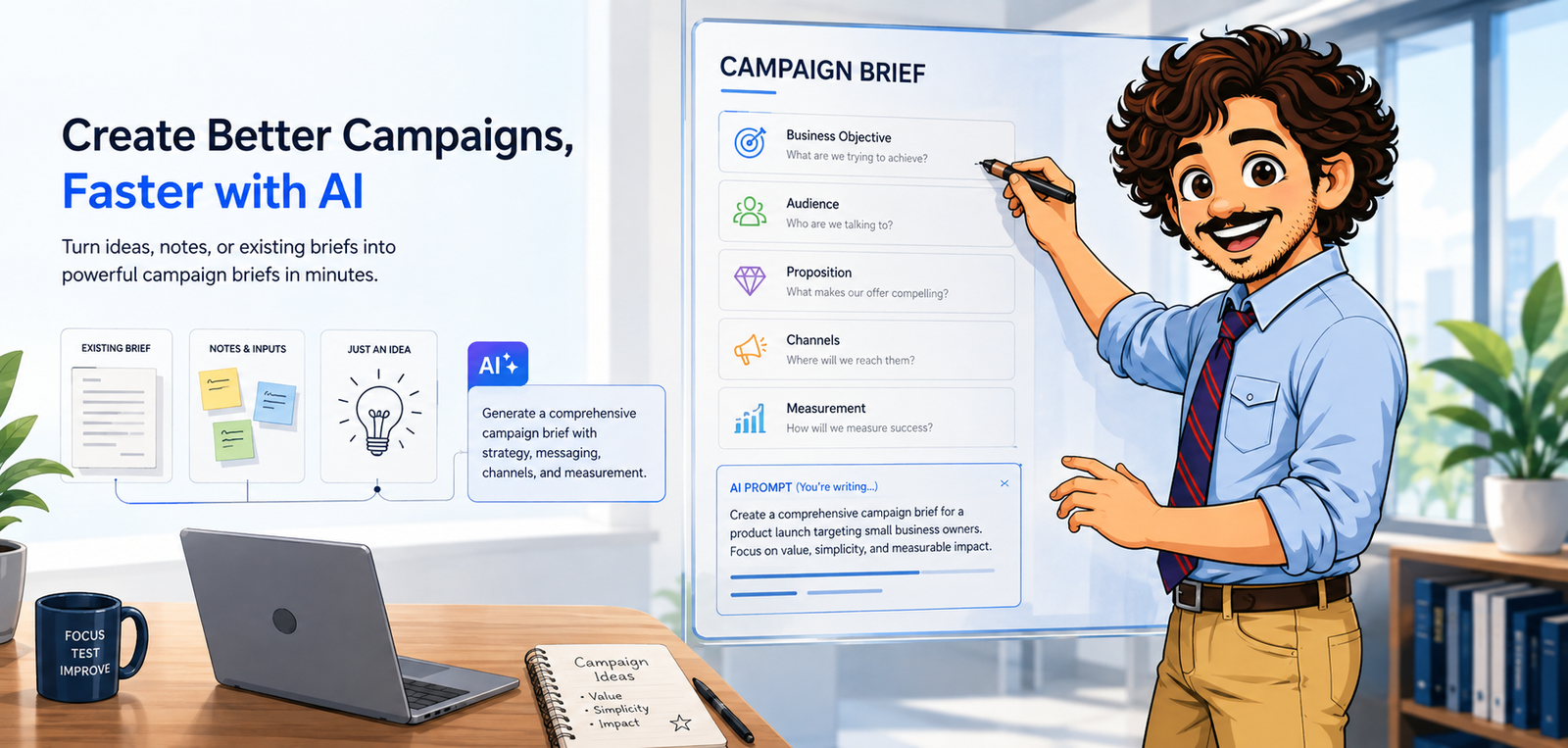
Ask ten B2B teams to send you their campaign brief and you'll get ten different objects back. A three-page template. A strategy deck. A page in Asana. A Jira ticket with four bullet points. A thread of meeting notes nobody has reread since the meeting. And at least one team that will tell you, honestly, that they don't really do briefs.
None of that matters as much as people assume. The question isn't whether a document called a campaign brief exists somewhere in the drive. It's whether the people building the campaign — media, creative, content, web, analytics, sales — are working from the same set of decisions. When they aren't, you tend to find out late and expensively: the ads promise something the landing page doesn't deliver, sales receives leads it never agreed to define as qualified, and everyone spends the post-mortem arguing about a KPI that was never the point.
AI is genuinely useful here, though not in the way it's usually used. The obvious move is to hand it a rough idea and ask it to produce the brief. It will, and the result will look impressive — audiences, insights, propositions, a channel mix, a measurement framework, all of it internally consistent. The problem is everything you didn't tell it. Where the information is missing, a language model doesn't leave a gap; it fills the space with something plausible, and by the time that text has been pasted into a deck and shared with three teams, a guess has quietly become the strategy.
So this playbook asks AI to do the opposite job. The prompt below won't write your brief until it has interrogated what you actually know, told you which decisions are still missing, and made you resolve the ones that could change the campaign. It's slower. It's also the difference between a document that looks finished and a campaign that is.
The Eight Decisions Behind Any Campaign
There's no universal brief format worth defending, but there is a short list of decisions I'd want settled before anyone spends real money. Together they make up what I've called the Campaign Brief Canvas:
- Business problem and objective — why this campaign exists at all, and what marketing is expected to change. "Launch a LinkedIn campaign" is an activity, not an objective.
- Priority audience — who you're actually trying to influence, and who matters most when the buying committee has five people in it.
- Customer situation — the trigger, tension or problem in the customer's world that makes the campaign relevant right now.
- Campaign proposition — the central reason anyone should care, connecting what the customer needs to something you can credibly claim.
- Desired action and customer journey — what you want people to do, whether that's realistic at their stage of consideration, and what happens after they do it.
- Channel and execution plan — the role each channel plays, plus deliverables, budget, timing, owners and approvals. A list reading "Google, LinkedIn, email, display" isn't a channel strategy.
- Measurement — the business outcome, the primary KPI, the leading indicators and the diagnostics, kept firmly separate from one another.
- Evidence, assumptions and risks — what you know, what you're inferring, and what you're quietly betting on without proof.
The names are negotiable. If your brief calls the first one "commercial challenge," that's fine. What matters is whether the thinking exists somewhere before production starts.
Keep Your Own Template
This is the part most AI frameworks get wrong, and it's worth being explicit about. If your company already has a campaign brief that works, keep it. Nothing is more tiresome than a prompt informing a team with years of established process that it now needs to restructure everything around somebody else's headings.
Use the Canvas behind your existing brief instead, as a quality-control layer rather than a replacement. Run your template through it and the framework tells you whether the important decisions are covered, without touching the format your organisation already understands. And if your team doesn't use briefs at all, the prompt will produce a short campaign alignment sheet instead — the same decisions, without introducing another document for the sake of having one.
Copy the Prompt
Act as a senior integrated marketing strategist and performance marketing leader with hands-on experience across campaign strategy, paid media, creative, content, web, CRO, analytics, marketing automation and sales alignment.
Your role is not to write a polished document. Your role is to help me think through the campaign, identify missing decisions, and turn the information I actually have into a useful campaign brief or alignment document.
ObjectiveHelp me create, structure, improve or validate the strategic information required to execute a marketing campaign, so that everyone working on it can make consistent decisions across strategy, creative, media, content, web, analytics, automation and sales.
Do not assume I already have a campaign brief. Do not assume my company uses the same format or terminology as other companies.
Possible starting pointsI may provide:
- A. Only a campaign idea or business request.
- B. Rough notes, meeting notes, a strategy document, presentation content or incomplete campaign information.
- C. An existing campaign brief or company template.
Determine which best describes my input. If I provide an existing company format, preserve that structure unless I ask you to change it. Use the framework below as a quality-control layer, not a mandatory replacement template.
Core rule: do not invent the strategySeparate all important information into four categories:
- Confirmed information — explicitly provided by me or contained in my materials.
- Reasonable inference — a conclusion that appears reasonable but has not been confirmed.
- Unsupported assumption — something the campaign relies on without sufficient evidence.
- Missing decision or evidence — information that cannot responsibly be determined from what I provided.
Never convert an inference or assumption into a confirmed fact. Do not invent customer research, pain points, ICP details, market data, competitor information, benchmarks, budgets, targets, conversion rates, channel performance, product differentiation, timelines or internal capabilities. If something important is unknown, tell me.
The Campaign Brief CanvasUse these eight areas to evaluate whether the important decisions exist.
- Business problem and objective — why the campaign exists, what problem or opportunity it addresses, what needs to change, the role marketing is expected to play, and whether the objective is clear and measurable enough to guide decisions.
- Priority audience — who the campaign is primarily trying to influence, relevant secondary audiences, decision makers and influencers, why this audience was selected, and whether evidence supports the prioritisation.
- Customer situation — what is happening in the customer's world, the trigger or tension making the campaign relevant, what the customer currently believes or does, what needs to change, and which insights are confirmed rather than assumed.
- Campaign proposition — the central idea, why the audience should care, the value offered, relevant differentiation and the evidence supporting important claims. Do not manufacture a USP if none has been provided or validated.
- Desired action and customer journey — what we want the audience to do, whether that matches their likely stage of consideration, what happens afterwards, the major steps between exposure and business outcome, and where friction exists.
- Channel and execution plan — proposed channels and the role of each, paid/owned/earned activity, deliverables, budget, timeline and milestones, creative or brand requirements, geographic or regulatory constraints, owners, approvals, and dependencies between teams. Do not recommend channels simply because they are commonly used.
- Measurement — primary business outcome, primary marketing KPI, secondary KPIs, leading indicators, diagnostic metrics, conversion events, tracking requirements, attribution considerations, and how performance connects to a meaningful business result. Do not treat vanity metrics as business outcomes.
- Evidence, assumptions and risks — which decisions are supported by evidence, which are inferences, which assumptions remain unsupported, what is missing, which unknowns could materially change the strategy, and what should be validated before significant production or media investment.
- Identify my starting point — classify my input as A, B or C and briefly explain why.
- Extract what is already known — summarise the useful information I have already provided. Do not ask me for anything already available in my input.
- Identify the critical gaps — review the information against the Canvas. Prioritise gaps that could materially change the objective, audience, proposition, creative direction, customer journey, channel strategy, budget allocation, deliverables or measurement. Ignore minor wording issues at this stage.
- Ask only the questions that matter — if critical information is missing, ask up to 7 questions in one batch, ordered from highest to lowest strategic importance. For each, briefly explain why the answer could affect the campaign. Do not ask questions simply because a traditional template contains a field. Stop after asking and wait for my answers. If enough information already exists, skip this step. If I tell you to proceed despite missing information, continue, but label every assumption clearly.
- Create or improve the brief — if I provided a company template, preserve its structure and improve it. If I provided notes, organise them into a clear campaign brief. If I have no formal brief and don't need one, create a concise campaign alignment sheet instead. Match the level of detail to the complexity of the campaign rather than padding for the appearance of rigour.
- Validate the result — review the finished document for misalignment between: business and marketing objectives; audience and customer problem; audience and proposition; proposition and creative direction; audience and channel choice; CTA and customer readiness; objective and KPI; media activity and customer journey; marketing process and sales process. Flag any strategic decision resting on an unsupported assumption. Do not invent contradictions to appear thorough.
Input: "We are launching accounting software for SMEs in Germany. We are considering Google Ads and LinkedIn and want to generate demo requests."
Good analysis — Confirmed: the product is accounting software; Germany is the market; SMEs are the stated audience; Google Ads and LinkedIn are under consideration; demo requests are the proposed conversion action. Missing: which SME segments are the priority; which roles participate in the decision; what problem triggers consideration; what differentiates the product; why those two channels were selected; whether a demo suits this audience; how a qualified demo is defined.
Bad analysis — "CFOs at German SMEs are the primary decision makers and LinkedIn is the best channel to reach them." Neither statement was established by the input.
Follow the good analysis behaviour throughout.
Final output format- Executive campaign summary — the campaign understandable in about one minute.
- Campaign brief or alignment sheet — the working document, using my company format if one was supplied. Mark unresolved decisions [DECISION REQUIRED] and inferences [INFERENCE — CONFIRM].
- Canvas check — a table covering all eight areas with columns for Area, Status, What is clear, What remains unclear, Recommended action. Status labels: CLEAR / PARTIALLY CLEAR / DECISION REQUIRED.
- Assumptions and evidence — organised into confirmed information, reasonable inferences, unsupported assumptions, and missing decisions or evidence.
- Five priority actions — the five decisions that would most improve the campaign before execution. Do not spend this section on cosmetic improvements.
- Campaign readiness — choose one: READY FOR EXECUTION / READY WITH MINOR CLARIFICATIONS / NOT READY — KEY DECISIONS REQUIRED. Explain briefly.
Before responding, verify that you have not invented insights, evidence or performance data; have not presented assumptions as facts; have preserved my company format where requested; have asked questions only where the answer could meaningfully affect the campaign; have addressed strategic rather than cosmetic issues; have connected measurement to meaningful outcomes; and have not hidden unresolved decisions.
My campaign information--- BEGIN INPUT ---
[Paste your campaign idea, notes, strategy or existing brief here]
--- END INPUT ---
Start From Whatever You Actually Have
There's no preparation step here, which is deliberate. Paste the prompt, then paste whatever exists today underneath it, and the model works out which of three situations it's in.
If all you have is a sentence — "we need a campaign for the new accounting platform in Germany" — it should interview you rather than produce a beautiful five-page brief built on invented customer insight. If you have meeting notes, a half-finished strategy or a deck someone made in a hurry, it extracts what's already decided, flags what's missing, and structures the rest once you've filled the gaps. And if you already have a completed brief, it keeps your structure, looks for what's unclear or contradictory, and uses the Canvas to check whether anything important was left out.
The seven-question limit matters more than it looks. A model given free rein will happily send you a forty-question audit covering every field a traditional template has ever contained, most of which won't change a single decision. Seven forces it to work out which unknowns are actually load-bearing.
The Part AI Shouldn't Do for You
Take that German accounting software example again. It's one sentence, and it genuinely tells you a fair amount: the product category, the market, the broad audience, two candidate channels and a proposed conversion action.
What it doesn't tell you is which type of SME matters most, who inside those companies signs off, what problem is pushing them to look for new software in the first place, why this product is different from the four alternatives they're also evaluating, whether a demo request is a realistic ask at that stage, what a qualified demo even means to the sales team, or what acquisition can cost before the economics stop working. Those seven unknowns are the campaign. Everything else is production.
Left alone, AI will answer all of them for you in confident, well-organised prose, and nothing in the output will indicate which parts came from you and which parts it made up. That's why the prompt insists on the four-way split between confirmed information, reasonable inference, unsupported assumption and missing evidence — not because the labels are elegant, but because they're the only thing standing between a working document and a very persuasive guess.
The Point
Most conversations about AI in marketing are still about speed: write the ads, build the page, generate the emails, produce the report. Useful, obviously. But there's a quieter opportunity in using it to challenge what you're about to do before you start doing it, when changing your mind is still cheap.
That takes a different relationship with the tool. Don't hand it an incomplete idea and let it fill the silence. Give it what you genuinely know, make it show you what you don't, and keep the decisions that matter where they belong — with the people who understand the business.
Which is really the whole idea behind this one. Don't ask AI to write your campaign brief. Ask it to make you think one through.