
AI Marketing Playbook #003: Validate Your Ideal Customer Profile Like a Senior Performance Marketer
Use AI to validate your Ideal Customer Profile with an expert framework. Identify gaps, buying signals, messaging opportunities, and targeting improvements.
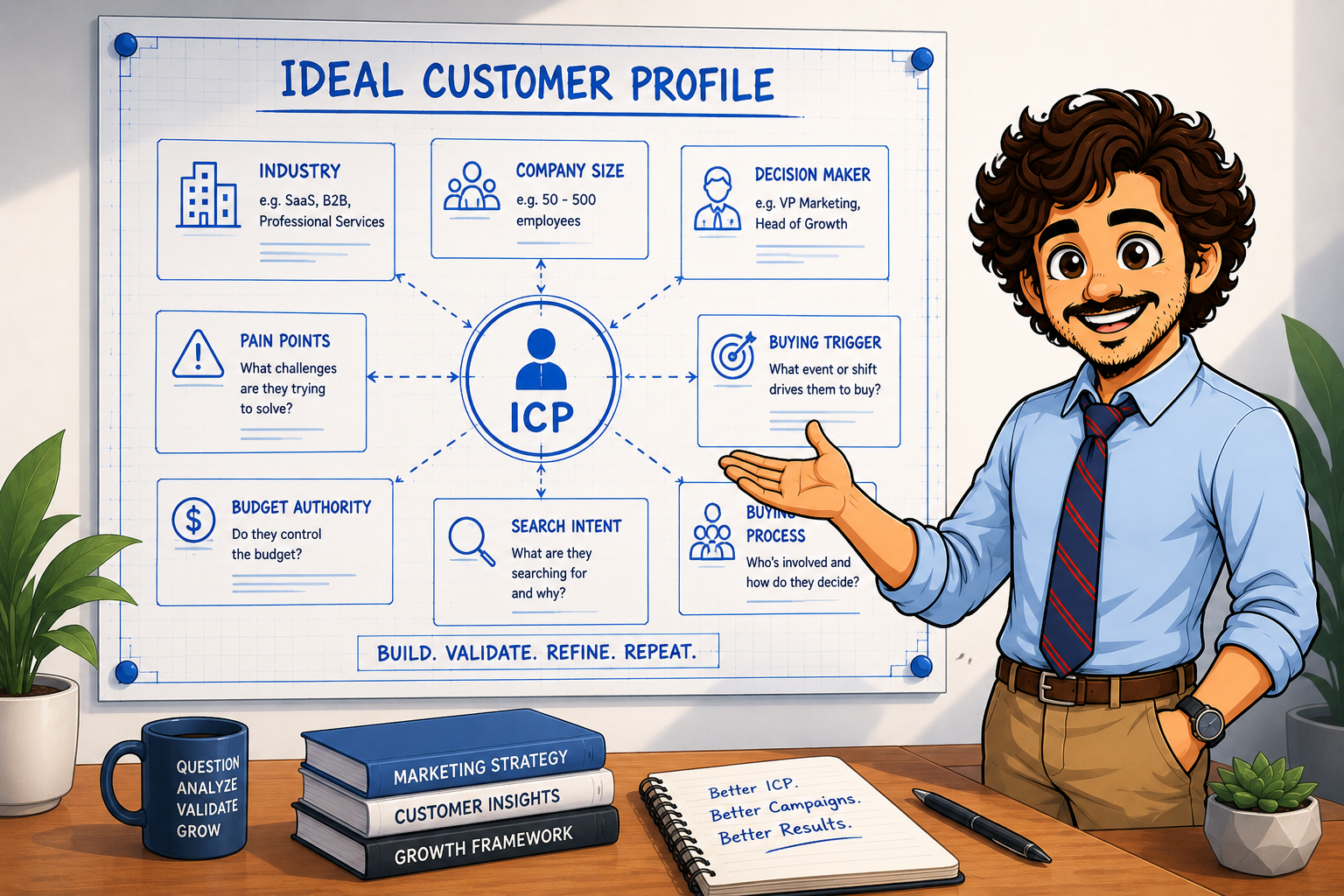
Almost every marketing team has an ICP sitting somewhere in a slide deck. What's rarer is a team that actually knows whether it still holds up.
Most Ideal Customer Profiles were built in a workshop a couple of years ago, borrowed from a template, or stitched together from assumptions nobody's revisited since. They tend to describe the customer a company wishes it had, not the one that actually signs the contract.
And when the ICP is off, you feel it everywhere. You end up targeting the wrong companies, your ads get more expensive than they should be, your messaging starts to sound generic, sales complains about lead quality, and content quietly struggles to reach the people who'd actually care about it.
AI can genuinely help here — but only if you ask it to do the right job. The temptation is to hand AI a blank page and ask it to invent an ICP from scratch. That's the wrong prompt. What you actually want is for AI to interrogate the ICP you already have: poke holes in it, flag what's missing, and tell you what needs to be checked against real customer data before you trust it again.
That's what this playbook is built to do.
Copy the Prompt
Act as a Senior B2B Performance Marketing Strategist, Demand Generation Leader, Customer Research Specialist, and Revenue Operations Consultant with more than 20 years of experience helping SaaS, technology, B2B services, ecommerce, and enterprise organizations define, validate, and optimize their Ideal Customer Profiles (ICP).
Your task is NOT to create an ICP from scratch.
Your task is to critically evaluate, challenge, improve, and validate my existing ICP using performance marketing, sales, CRM, analytics, and customer research best practices.
Avoid generic marketing advice. Think like a Chief Marketing Officer preparing a multimillion-dollar go-to-market strategy.
- My Company: [Describe your company]
- Products / Services: [Describe your offer]
- Current ICP: [Paste your current ICP]
- Known Customers: [Describe your best existing customers]
- CRM Insights: [Paste any available CRM data]
- Win/Loss Analysis: [Describe why deals were won or lost]
- Sales Objections: [List common objections]
- Competitors: [List competitors]
- Marketing Channels: [Google Ads, LinkedIn, SEO, Email, Events...]
Please complete the following sections:
- ICP Quality Score (0-100)
- Biggest assumptions that require validation
- Missing customer information
- Buying triggers
- Business pains
- Buying committee analysis
- Decision-making process
- Budget authority
- Technology stack indicators
- Search behaviour
- Content consumption habits
- Sales objections
- Competitive alternatives
- Market maturity
- High-intent buying signals
- Low-quality lead indicators
- Ideal messaging themes
- Recommended Google Ads audiences
- Recommended LinkedIn targeting
- SEO opportunities
- Landing page messaging recommendations
- Suggested lead magnets
- Suggested nurture strategy
- Questions I should ask customers to validate the ICP
- Missing CRM data that should be collected
- Risks of using this ICP
- Executive summary
For every recommendation:
- Explain WHY.
- Explain the business impact.
- Explain how to validate it using evidence.
Never invent facts. Clearly distinguish assumptions from validated insights. Whenever possible, recommend customer interviews, CRM analysis, search intent research, and sales feedback before making strategic decisions.
How to Get Better Results
None of this works if you feed the model an empty ICP and a vague sense of who your customers are. The output is only as sharp as the evidence behind it, so it's worth pulling together whatever real data you have before you run the prompt: CRM reports, sales call notes, win/loss analysis, GA4 data, Search Console queries, LinkedIn campaign performance, customer interviews, support tickets, product reviews. The more of that you feed in, the less the model has to guess.
Because guessing isn't really the point here. You're not asking AI to make something up — you're asking it to think critically about what you already believe, with real evidence sitting in front of it.
What AI Usually Gets Wrong
This is the part where marketers should stay a little skeptical. AI is genuinely good at spotting patterns, but it has no way of knowing whether those patterns actually describe your customers or just resemble the thousands of similar-sounding examples it's seen before. Ask it to describe your ideal customer and it will hand you something that sounds entirely plausible — confident, specific, well-organized — and that's exactly the problem. Plausible isn't the same as true.
So treat everything it gives you as a hypothesis, not a conclusion, and check it against the things that actually reflect your business: CRM data, customer interviews, sales feedback, search behaviour, campaign performance, revenue data. Your best customers are the ones who should be defining your ICP. AI's job is to help you see them more clearly, not to replace the thinking that follows.
Final Thoughts
An Ideal Customer Profile is one of the more consequential documents a marketing team produces, quietly shaping targeting, messaging, campaign performance, content, SEO, paid media, and every sales conversation that follows. AI can speed up how quickly you stress-test it, surface blind spots you'd otherwise miss, and push back on assumptions that have gone unchallenged for too long.
What it shouldn't do is replace the evidence. The strongest ICPs still come from the same place they always have — a mix of real marketing data, CRM insight, and honest conversations with actual customers, with AI used to sharpen the thinking rather than substitute for it. That combination is what gives you something no model can hand you on its own: real confidence that you're going after the right people.