
AI Marketing Playbook #002: Audit Your Google Ads Campaign Like a Senior Performance Marketer
Audit your Google Ads campaigns with this expert AI Marketing Playbook. Identify wasted spend, improve targeting, optimise keywords, and increase campaign performance.
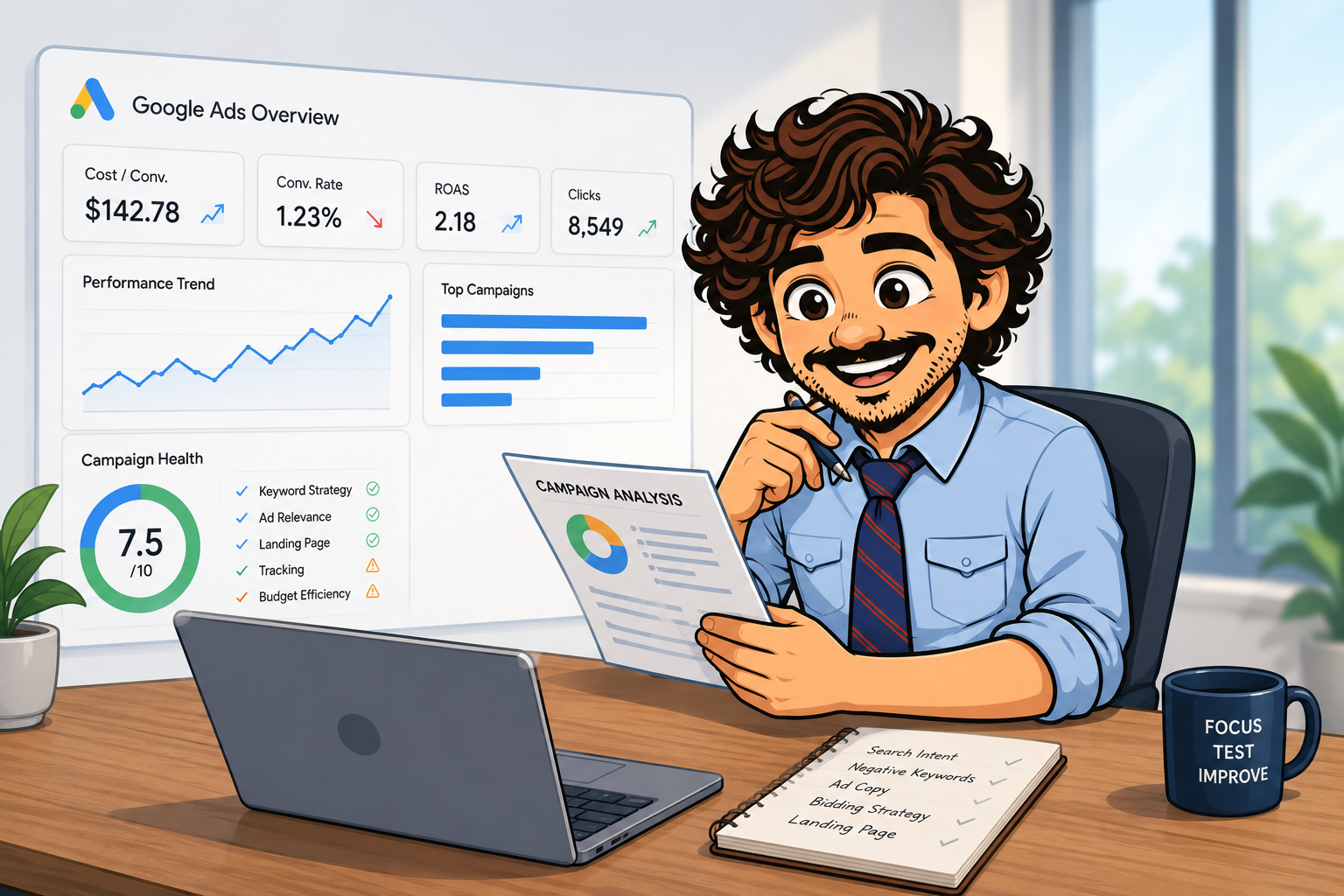
A campaign that was working stops working. Cost per conversion creeps up, CTR slides, and the leads that used to arrive steadily now cost noticeably more to acquire.
The first instinct is almost always the same: raise the budget, adjust the bids, write new ads. Occasionally that's the right call. More often it's treating a symptom while the actual cause sits somewhere else entirely — search intent that drifted, keywords that were never a good fit, an audience mismatch, a tracking gap quietly under-reporting conversions, or a bidding strategy that made sense six months ago and doesn't now.
AI is genuinely good at surfacing these patterns quickly. What it won't do is volunteer them. Ask it to "optimise my Google Ads campaign" and you'll get the same generic checklist everyone else gets. Ask it the way a senior consultant would work through an account, and the output changes completely.
That's what this playbook is for.
Copy the Prompt
Act as a Senior Google Ads Consultant with more than 20 years of experience managing high-performing B2B and B2C campaigns.
Review my Google Ads campaign and identify the biggest opportunities to improve performance.
- Campaign objective: [Lead generation / Ecommerce / Awareness]
- Industry: [Describe your business.]
- Target audience: [Describe your ICP.]
- Monthly budget: [$...]
- CTR:
- Conversion Rate:
- CPA:
- ROAS:
- Impression Share:
- Quality Score:
- Top Search Terms:
- Campaign structure: [Describe your campaigns.]
- Landing page: [URL]
Please analyse:
- Campaign structure
- Keyword strategy
- Match types
- Negative keywords
- Search intent
- Ad relevance
- Headlines
- Descriptions
- Extensions
- Quality Score
- Bidding strategy
- Audience targeting
- Conversion tracking
- Landing page alignment
- Budget allocation
- Biggest wasted spend
- Quick wins
- Long-term improvements
For every recommendation:
- Explain why it matters.
- Estimate business impact.
- Suggest how to validate the change.
Finally provide:
- Five highest-priority actions.
- Three A/B tests.
- An overall campaign health score from 1–10.
Feed It Evidence, Not Assumptions
The quality of the audit tracks almost perfectly with the quality of what you paste in. A prompt with three KPIs gets you a plausible-sounding guess. A prompt with a search terms export gets you something you can act on Monday morning.
Worth including where you have it: your search terms report, device and geographic breakdowns, audience segment performance, the conversion actions you're actually counting, whatever you know about competitors in the auction, and any changes made in the last 30–60 days. That last one matters more than people expect — a lot of "sudden" performance drops have a change log entry sitting right underneath them.
What a Filled-In Brief Looks Like
Industry: B2B HR software. Goal: Generate qualified demo requests. Budget: €20,000/month. Primary KPI: Cost per qualified lead.
Short, but every line narrows the analysis. "Qualified" in that last line alone rules out half the advice a model would otherwise give you.
Where AI's Judgement Runs Out
AI reads patterns in the data you hand it. It has no view of the things that aren't in the data — seasonality, what your sales team actually does with the leads, which accounts closed and which quietly churned, a competitor running an aggressive promotion this quarter, whether your team even has the capacity to handle more volume, or broader market conditions moving underneath all of it.
Treat the output as a well-argued second opinion. Validate it against your own account before you act on it.
The Mistakes It Makes Most Often
There are a few failure modes that show up repeatedly, and they're worth recognising on sight:
- Over-weighting CTR as a health signal
- Treating lead volume as lead quality
- Reaching for broad match too early
- Assuming Smart Bidding will solve structural problems
- Skipping incremental testing in favour of sweeping changes
- Defaulting to the idea that more traffic is better
Most of these share a root cause: platform metrics are easy to optimise toward, and business outcomes aren't. Your job is to keep pulling the analysis back toward the second one.
The Point
Google Ads optimisation rarely comes down to making thirty small adjustments. It comes down to finding the two or three changes that actually move the business — and AI can compress that search from days into an afternoon.
Used well, it's another analyst on the team. Used lazily, it's another source of advice you already knew. The difference is entirely in what you ask it and what you're willing to check afterwards.