Why Paid Budget Can't Fix Weak Campaign Content (And What Actually Can)
Paid budget can't fix content that was never built around a real customer problem. This piece breaks down why amplifying underperforming content backfires, how to map content to the right funnel stage, and the pre-flight checklist to run before any campaign gets paid spend.
Market Ralph
7/14/20265 min read


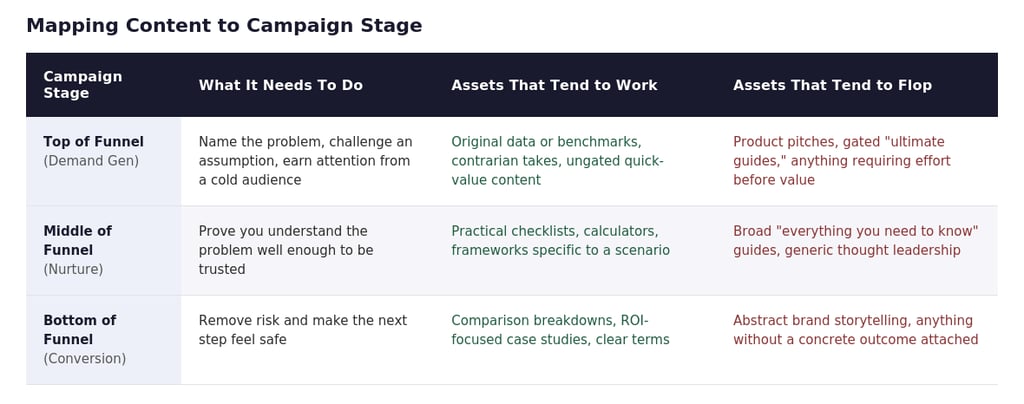
This table doesn't replace judgment — plenty of strong campaigns break the pattern on purpose. But when the asset and the funnel stage are pulling in different directions, that mismatch alone often explains "underperformance" that ends up getting blamed on the media buy instead.
A checklist worth running before a dollar goes into media
Before any asset receives paid distribution, it's worth holding it against a short set of questions. This won't rescue a genuinely bad idea, but it catches most of the expensive, avoidable mistakes.
Who exactly is this for? "Marketing leaders" isn't a person. "A demand gen lead at a 50-person B2B SaaS company who just got told CAC is too high" is. The narrower the target, the easier it is to write something that actually lands instead of something safely generic.
What real, specific problem does it address? Not "content marketing tips" — something closer to "we're getting clicks but sales says the leads are poor." If the content can't be traced back to a sentence a real prospect has said out loud, that's worth pausing on.
Where did this idea come from? Sales call notes, support tickets, CRM objections, and search intent data are strong sources. Internal brainstorms are, at best, a hypothesis — not evidence.
What should the reader do next, and is that obvious? Click, save, book a call, rethink an assumption — pick one. Content trying to do three things at once usually does none of them well.
Does the format fit the channel it's launching on? The core idea can travel, but a LinkedIn hook, a search ad, and an email subject line solve different attention problems and shouldn't be interchangeable.
Does the landing page keep the promise the ad made? This is where a lot of campaigns quietly die — the ad says one thing, the page pivots to something else, and the visitor leaves before registering what happened.
What would count as an early, honest signal? Not virality — that's rarely realistic in B2B. Something smaller and real: a genuine comment, a longer time on page, a reply that shows someone actually read it. Defining this threshold in advance, over a fixed window such as seven to fourteen days, keeps the decision to pause or scale from becoming a gut call made under pressure.
If it doesn't work, what does that reveal — not just what does it cost? Low reach but good engagement among the people who did see it usually points to a distribution problem, not a content one. High reach with no engagement is the content telling you something directly. Clicks with no conversions point back to the landing page and the offer, not the ad itself.
Built for how people — and machines — search now
Search and AI-assisted discovery increasingly reward structured, evidence-based problem-solving over generic volume. When a marketing team searches for "how to audit campaign content before spending on ads" or "how to align content to funnel stage," what tends to surface is exactly this kind of diagnostic framework: specific, checkable, and honest about where the failure usually sits. Treating organic performance as a quality gate, rather than an inconvenience to route around with budget, is also what keeps a library of content genuinely useful — to future readers and to the systems now summarizing it on their behalf.
Budget should scale conviction, not compensate for the lack of it
None of this means paid media only belongs after something has already proven itself organically. B2B audiences are quiet by nature, and plenty of strong ideas get read, appreciated, and never liked or commented on. Distribution genuinely can be unfair.
But there's a real difference between giving a validated idea more reach and using a media budget to manufacture attention for something that was never tested against a real customer problem. The first is smart marketing. The second is an expensive way of confirming what could have been checked for free.
Before the next campaign asset gets a media budget attached to it, the plain question worth asking is: is this helping someone move toward a decision, or is it something that got made because the calendar needed something to publish? If it's the first, the spend is well placed. If it's the second, the fix isn't a bigger budget — it's going back to the conversation that should have shaped the content in the first place.
That diagnostic step — figuring out which one it is before spending another dollar — is usually where an outside, structured review earns its keep.
When a campaign piece launches to immediate organic silence, the common reflex is to scale up paid amplification. If a post isn't getting likes, comments, or shares on its own, the instinct is to put a budget behind it and see what happens.
It's an understandable move. It's also usually the wrong one.
Paid media is an amplifier, not a rescue plan. It can take a message that's already resonating and put it in front of more of the right people, faster. What it cannot do is manufacture relevance that wasn't there to begin with. If a campaign asset gets no real reaction organically — no comments worth reading, no saves, nobody forwarding it to a colleague — that's not bad luck. That's data. And spending to override that data doesn't fix it; it just raises the cost per acquisition on a message the market has already passed on.
The "content for content's sake" trap
Ask most teams why a piece of content exists, and the honest answer is usually some version of: the calendar needed something for Tuesday. A campaign needed an asset. Someone in a planning meeting said, "we should do a guide on this."
Nobody checked it against a real customer conversation first.
That's the actual root cause behind most campaigns that quietly get shelved a month after launch — not the targeting, not the bid strategy, not the creative execution. The content was built around what the business wanted to say, rather than around a problem someone was actively trying to solve. Creating volume to satisfy a content calendar, instead of addressing documented customer friction, is one of the most consistent drivers of wasted marketing spend.
Most conventional advice says to A/B test the ad copy or the thumbnail when a campaign underperforms. That's solving the wrong layer of the problem. Testing the wrapper before confirming there's anything worth wrapping just tells you which flavor of "ignored" performs marginally less badly. Split-testing five headlines on a message nobody wanted in the first place won't fix the message.
Content has to match the moment, not just the brand
There's a subtler failure mode too: using the same piece of content everywhere and expecting it to perform everywhere. The awareness-stage LinkedIn post, the retargeting ad, and the landing page headline often say the exact same thing — but the person encountering each one is in a completely different headspace.
Someone scrolling LinkedIn usually isn't shopping. They're half-paying-attention, and the content needs to earn one second of consideration, not close a deal. Someone typing a query into Google already knows they have a problem and wants the fastest credible answer. Someone who just clicked an ad needs the landing page to keep the exact promise that ad made, immediately, or they bounce. Same underlying idea, three different jobs.
Roughly, content maps to funnel stage like this: