
How to Discover What Your Customers Are Asking AI with Perplexity
Learn how to use Perplexity to discover what your customers are asking AI. A practical guide for performance marketers to uncover buyer intent, objections, and decision signals.
Market Ralph
4/14/20263 min read
What you will learn
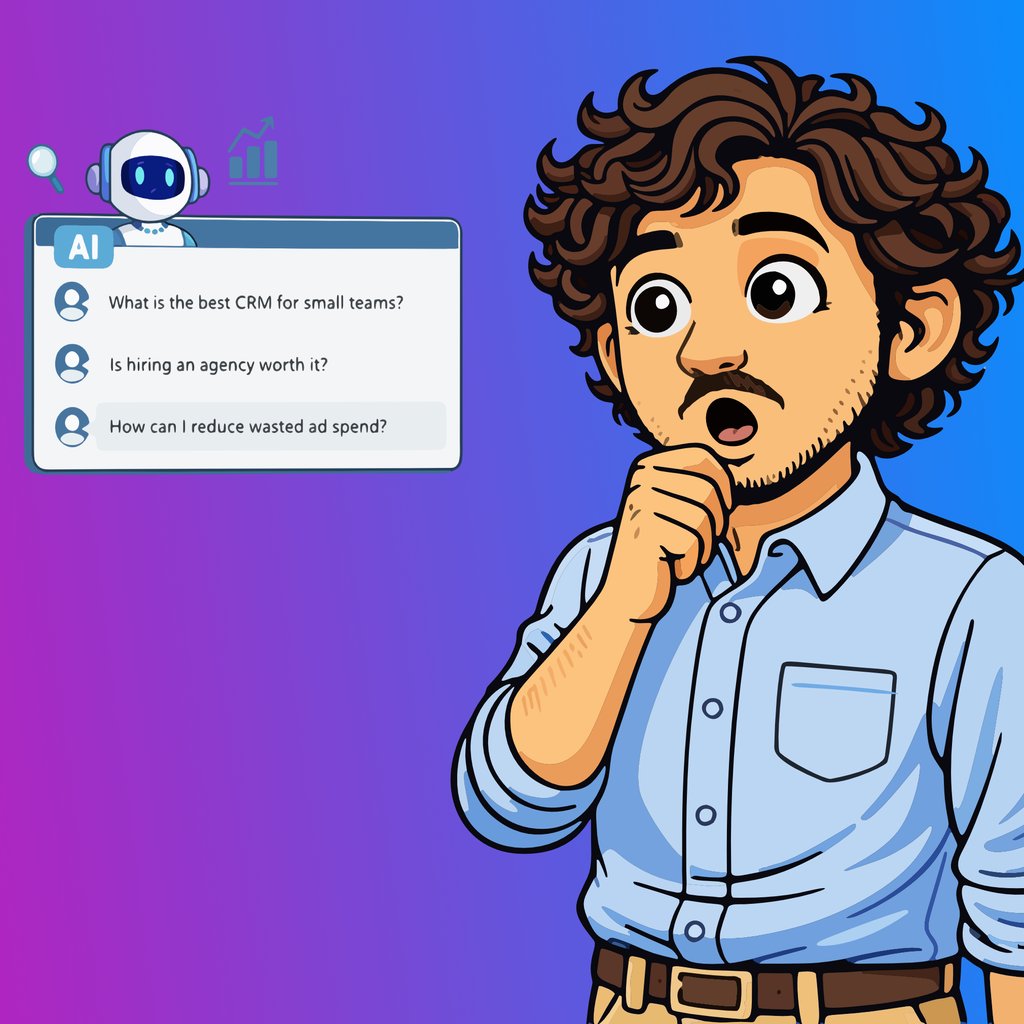
In this guide, you will learn how to use Perplexity AI to discover what your customers are asking AI, how to extract real buyer intent, and how to turn those insights into better ads, landing pages, and performance marketing campaigns.
Why understanding what customers ask AI matters
People are no longer starting their journey with short keywords and a list of links. Instead, they are asking full questions inside AI tools, comparing options, and forming opinions before visiting a website.
For performance marketers, this means that part of the funnel — awareness and consideration — is now happening inside AI-generated answers as I mentioned in my previous article "The Evolution of "TOFU" (not the food)".
Understanding what customers ask AI is therefore critical, because it reveals:
real questions
hidden objections
comparison logic
decision triggers
This is where intent is formed.
What is Perplexity and why marketers should use it
Perplexity AI is an AI-powered answer engine that searches the web in real time, provides cited responses, and allows users to explore topics through natural language.
For marketers, Perplexity is useful because it:
reflects how users ask questions in AI
aggregates real sources
reveals patterns across multiple perspectives
simulates buyer research behavior
In simple terms, it helps you understand how customers think before they convert.
How to use Perplexity to discover customer intent
The process itself is simple, but it works best when you treat it as a guided flow rather than a checklist.
Start by defining one clear audience and one specific situation. Avoid trying to understand everyone at once, and instead focus on a moment that matters, such as a B2B marketing leader evaluating agencies, an ecommerce brand struggling with acquisition costs, or an HR director comparing recruitment platforms. The more precise the context, the more useful the insight.
Once that is clear, begin by asking discovery questions that reveal how people think before they buy. A simple prompt like “What questions does a [persona] ask before investing in [category]?” will immediately surface language that feels far closer to real buyers than traditional keyword research.
From there, move naturally into pain and friction. Ask what frustrates them, what slows them down, and what creates uncertainty. This is where you begin to uncover the emotional drivers behind decisions, not just the functional ones.
The next step is to explore hesitation. By asking what concerns or risks stop people from choosing a solution, you start identifying the exact points where conversions are lost. Strong campaigns are often built not on what you say, but on what you remove as a barrier.
Then shift into comparison. Ask what buyers evaluate when choosing between options, and you will start to see the real decision criteria emerge, whether it is cost, speed, ease of use, control, or perceived risk.
Finally, bring structure to everything you have gathered. Ask Perplexity to group the insights into pain points, objections, desired outcomes, and decision criteria. This transforms scattered observations into something you can directly apply to your campaigns.
How to turn AI insights into better campaigns
Once you understand what customers are asking AI, you can directly improve performance marketing.
For example:
If customers worry about wasted budget → lead with ROI and control
If customers compare onboarding → highlight speed and simplicity
If customers hesitate due to complexity → simplify messaging
This alignment between intent and messaging improves:
click-through rate
conversion rate
lead quality
Using Perplexity for competitor analysis
Instead of asking which company is better, ask what customers actually compare when evaluating Competitor A versus Competitor B, as this reveals how decisions are made rather than what people claim to prefer. This reveals:
decision factors
perceived weaknesses
positioning gaps
Focus on friction, not opinions.
How to find gaps in your landing pages
A simple way to identify what your landing page might be missing is to look at what buyers actually expect before making a decision. You can start by asking What information do buyers need before choosing [your category], and then compare those expectations with your current landing page. If key elements are missing, such as:
pricing clarity
proof (case studies, results)
onboarding explanation
integrations
support details
Then you likely have a conversion gap, not a traffic problem.
Best prompts you can use today
Use these directly in Perplexity AI:
“What questions do potential buyers ask before choosing a performance marketing agency?”
“What objections do companies have when choosing between in-house and agency?”
“What concerns do marketers have when trying to improve Google Ads performance?”
How this impacts SEO and LLM visibility
We are moving from: Ranking pages → Being included in answers.
To improve visibility in AI-driven platforms:
use clear headings
answer questions directly
structure content logically
include explicit definitions
avoid vague language
This makes your content easier for AI systems to extract and cite.
Simple workflow for marketers
Open Perplexity
Choose one audience
Ask discovery, pain, objection, and comparison questions
Group insights
Validate sources
Translate into campaigns
Final takeaway
Understanding what your customers ask AI is becoming a competitive advantage. Because if you align your messaging with how people think before they click, your campaigns will naturally perform better. Not because you optimized for algorithms, but because you optimized for intent.