
How to Spot a Weak Performance Marketing Campaign Before You Spend the Budget
Use this performance marketing campaign audit to check your offer, landing page message match, creative, tracking, and campaign intent before spending budget.
Market Ralph
5/12/20269 min read
A practical performance marketing campaign audit for offers, landing pages, creative, tracking, and AI signals
Most campaigns are reviewed too late.
The campaign goes live, the budget starts spending, the dashboard fills with data, and only then do teams begin asking the difficult questions.
Why is the cost per click so high? Why is the conversion rate so low? Why are the leads not good enough? Why is the algorithm not learning? Why is the platform not performing?
At that point, everyone starts looking inside the ad platform. The bidding strategy is questioned. The audience is questioned. The budget is questioned. The creative is questioned. The platform is blamed.
Sometimes that is fair. But very often, the campaign was weak before the first impression was ever served. The problem was not created by the platform. The platform simply exposed it.
That is why a performance marketing campaign audit should not happen only after a campaign has spent money. It should happen before launch, when there is still time to fix the foundations. Because some campaigns do not fail because they were badly optimized.
They fail because they were badly prepared.
What is a weak campaign foundation?
A weak campaign foundation is rarely one single problem. It is usually a combination of unclear inputs that make the campaign harder to understand, harder to optimize, and harder to scale.
The offer may be too vague. The audience may be too broad. The ad may create a promise that the landing page does not continue. The creative may look good but say nothing meaningful. The conversion goal may reward activity instead of business value. The tracking may tell the platform that every lead is equal, even when sales knows that is not true.
This is where many campaigns start to break. Not inside Google Ads, LinkedIn, Meta, or any other platform, but in the thinking that happens before the campaign is built.
A strong campaign gives the platform and the buyer a clear reason to act. A weak campaign asks the platform to figure out what the business has not clearly defined. That becomes even more dangerous in the AI era.
AI-powered advertising systems can optimize faster, test more combinations, and make more delivery decisions, but they still depend on the quality of the signals they receive. If the campaign feeds the system unclear messaging, weak conversion data, poor landing pages, or generic creative, AI does not automatically fix the problem.
It may simply scale it faster.
Start with the five-second offer test
The first question in any campaign audit should be simple.
Can someone understand the offer in five seconds?
A buyer should quickly understand who the offer is for, what problem it solves, and why it matters. If someone needs to read three paragraphs before understanding the value, the campaign is already creating friction.
This does not mean every offer must be oversimplified. Complex B2B products, high-value services, and technical solutions often need explanation. But the first impression should still create direction.
The visitor should not be left thinking, “What do they actually do?”
This is where many companies hide behind safe language. They say they help businesses “unlock growth,” “drive transformation,” “improve efficiency,” or “accelerate innovation.” These phrases may sound professional, but they often fail because they could describe almost any company.
A clear offer is more specific. It tells the buyer who the solution is for, what pain it addresses, and what outcome it creates. It does not try to impress everyone. It tries to be understood by the right people. That is the first sign of a stronger campaign foundation.
Check the landing page message match
The landing page is one of the most important parts of any campaign, but it is often treated as the place where traffic goes after the “real” campaign work is done. That is a mistake. The landing page is where the promise of the ad is either confirmed or broken.
If the ad talks about reducing wasted media spend, the landing page should continue that exact idea. If the ad speaks to B2B marketing leaders, the page should feel like it was built for B2B marketing leaders. If the ad promotes a specific report, offer, demo, or service, the page should not feel like a generic homepage.
This is landing page message match, and it matters more than many teams like to admit.
But message match is not only about copy. It is also about design, tone, and brand consistency.
If the ad feels premium but the landing page looks cheap, trust drops. If the ad is specific but the page is generic, attention drops. If the ad uses one visual language and the page looks like a completely different brand, confidence drops.
The buyer may not consciously analyze all of this, but they feel the disconnect.
A good campaign experience should feel continuous. The ad should create the expectation, and the landing page should immediately confirm that the visitor is in the right place.
When that connection is weak, the campaign has to work harder for every conversion.
Do not judge every campaign the same way
A common mistake in performance marketing is using the same success criteria for every campaign.
This is where old funnel thinking can still be useful, but also dangerous.
The classic funnel is becoming less linear. Buyers discover brands through LinkedIn, search, AI answers, communities, newsletters, videos, dark social, sales conversations, and competitor research. They may move from awareness to consideration and back again before ever visiting your website. So yes, the funnel is changing, but campaign intent still matters.
An awareness campaign should not be judged in the same way as a high-intent search campaign. A retargeting campaign should not be judged in the same way as a cold LinkedIn campaign. A demand generation campaign should not be judged only by immediate demo requests if the goal is to educate and create future demand.
This does not mean awareness campaigns should get a free pass. It means the audit has to match the purpose of the campaign.
For a high-intent search campaign, the landing page should answer the buyer’s immediate problem and make the next step obvious. For a retargeting campaign, the page may need stronger proof, comparison, objections, or reasons to return. For a demand generation campaign, the content may need to educate, frame the problem, and build trust before asking for a commercial action.
The question is not only, “Did this campaign convert?”
The better question is, “Did this campaign create the right action for the stage of intent it was designed for?”
That is a very different standard.
Audit the conversion before you ask AI to optimize
One of the biggest weaknesses in performance marketing is optimizing toward the wrong conversion.
This is especially dangerous now, because AI-powered platforms depend heavily on conversion signals. If you tell the system that every form fill is valuable, it will try to find more people likely to fill in the form. That does not mean it is finding better customers.
It may only be finding easier conversions.
This is why a campaign audit needs to check the quality of the conversion before the campaign launches.
Is the conversion action connected to business value? Does sales agree that this type of lead is useful? Is the form too easy, too difficult, or asking for the wrong information? Are all leads being treated equally, even when some clearly have stronger intent than others?
A demo request, pricing inquiry, contact form, newsletter signup, gated content download, and webinar registration are not the same thing. They can all be useful, but they should not all be treated as equal buying signals.
This is where cost per lead can become dangerous.
A low cost per lead may look good in the dashboard, but if those leads do not become opportunities, the campaign is not really performing. It is only producing activity.
Before launching a campaign, the team should be clear on what success really means. Not only what the platform can measure, but what the business actually values.
If the conversion goal is weak, the campaign will learn from weak signals.
Creative testing should test ideas, not just formats
Creative is often treated as decoration, but in modern performance marketing it is one of the most important inputs the campaign has.
The creative tells the platform what angles are available. It tells the buyer why they should care. It gives the campaign different ways to reach different motivations, pains, objections, and levels of awareness.
But many creative tests are too shallow.
A team may test five versions of the same message, change the background color, adjust the image, resize the asset, or rewrite the headline slightly. That may be useful for production, but it does not always teach the campaign much.
A stronger creative test asks bigger questions.
Which pain matters most to the buyer? Is the buyer more motivated by wasted budget, missed revenue, internal pressure, risk, speed, simplicity, or competitive advantage? Does proof perform better than fear? Does a practical angle beat a strategic one? Does the buyer respond more to a problem-led message or an outcome-led message?
That is where creative becomes useful for performance.
If every ad says the same thing in slightly different words, the campaign is not learning enough. It is only creating more versions of the same idea.
Before launch, ask whether the creative gives the platform meaningful differences to test.
If it does not, the campaign may spend money before it has a real learning plan.
Check whether the landing page answers the buyer’s next question
A good landing page does not just repeat the ad. It continues the conversation.
The ad creates the click by making a promise or creating curiosity. The landing page has to answer the buyer’s next logical question.
If the ad says, “Stop wasting budget on campaigns that do not convert,” the page needs to explain why budget is being wasted, how the solution helps, who it is for, what proof exists, and what the visitor should do next.
If the page only repeats the same generic claim, it does not move the buyer forward.
This is where many landing pages fail. They talk about the company before the buyer. They describe features before the pain. They add proof too late. They hide the next step. They make the visitor work too hard to understand why the offer matters.
A strong page should make the buyer feel understood before asking them to act.
That is also good for AI and GEO.
AI systems need clear, structured, answerable content to understand what a page is about. A landing page that clearly explains the audience, problem, solution, proof, and next step is not only better for conversion. It is also easier for search engines and AI assistants to interpret.
This is why landing page clarity now supports performance marketing, SEO, and generative engine optimization at the same time.
Make the campaign AI-readable (As mentioned in previous articles)
AI-readability is not about writing for robots. It is about removing unnecessary confusion.
A campaign is AI-readable when the ad, landing page, content, and conversion signals all point in the same direction.
The system should be able to understand who the offer is for, what problem it solves, which page is relevant, what action matters, and which users are more likely to create value. That requires consistency.
If the ad talks about one problem, the landing page should not focus on something else. If the campaign is built for one buyer, the page should not speak to everyone. If the conversion is meant to represent commercial interest, it should not be mixed with low-intent actions that confuse the signal.
This is where GEO and performance marketing connect.
Generative engine optimization is often discussed as a content or SEO topic, but the same principle applies to paid media. AI systems need clean signals, clear language, consistent entities, useful explanations, and pages that can be understood without guessing.
The more automated marketing becomes, the more important this consistency becomes.
Not because AI replaces strategy, but because AI depends on strategy being clear enough to use.
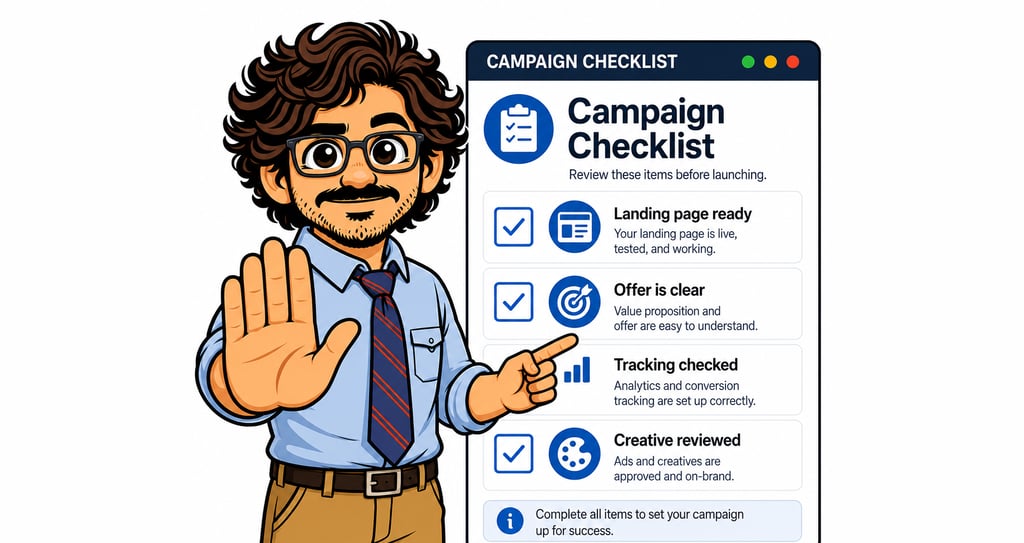
The campaign audit checklist
A good campaign audit does not need to be complicated.
Before launch, ask whether the campaign is clear enough for the buyer, the platform, and the business:
Can the offer be understood in a few seconds?
Does the ad match the landing page in message, tone, and design?
Is the campaign goal connected to the real stage of intent?
Is the conversion action valuable enough to optimize toward?
Is the creative testing different buyer pains or just different formats?
Does the landing page answer the buyer’s next question?
Can AI systems understand what the offer is, who it is for, and what action matters?
These questions are simple, but they force the right conversation.
They move the team away from “Is the campaign set up?” and toward “Is the campaign ready to work?” That is the difference.
A campaign can be technically ready and strategically weak. It can have the right tracking tags, the right budget, the right formats, and the right platform settings, but still fail because the message, offer, page, or goal is unclear.
That is why pre-launch diagnosis matters.
It is much cheaper to fix confusion before the campaign spends money than to discover the problem after the budget is gone.
Do not optimize what should be rebuilt
Not every campaign needs more optimization. Some campaigns need a better foundation.
If the offer is unclear, fix the offer. If the landing page does not match the ad, fix the page. If the conversion goal rewards the wrong behavior, fix the measurement. If the creative does not test real buyer pains, fix the creative strategy. If the campaign is being judged by the wrong criteria, fix the success definition.
Optimization is powerful when the foundation is strong.
But when the foundation is weak, optimization can become an expensive way to avoid the real issue.
This is why performance marketers need to move upstream. The job is no longer only to manage what happens inside the platform. It is to understand what the platform is being fed before the campaign goes live.
The best performance marketers will not only ask how to improve the campaign. They will ask whether the campaign deserves budget yet.
That is the question more teams should be asking. Because the campaign may not be broken after launch.
It may have been weak before it started.