
How to Use AI to Track Campaign Progress Before Performance Drops
Learn how to use AI to track campaign progress, spot weak signals earlier, and improve campaign optimization decisions with better weekly reviews. Get key insights using AI.
INSIGHTS
Rafael Echavarria
5/26/20267 min read
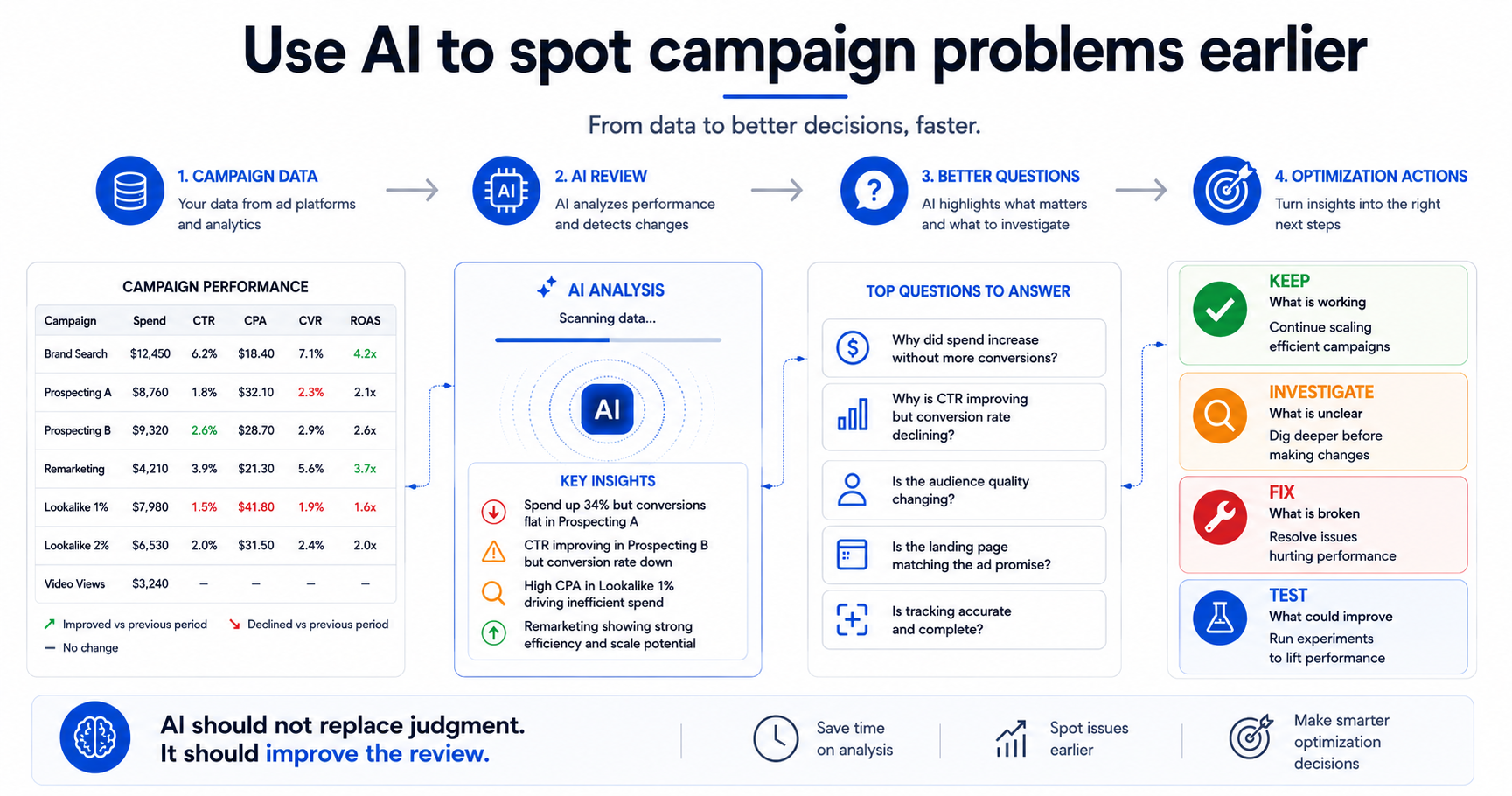
Most campaign dashboards are good at showing what happened. They show spend, impressions, clicks, CTR, CPC, conversions, CPA, ROAS, conversion rate, and revenue. For performance marketers, that information is useful, but it often arrives as a report rather than a diagnosis. The numbers may show that performance changed, but they do not always explain what needs attention next.
That is where AI can become useful.
Not as a replacement for strategy, and not as a tool that should blindly move budgets or rewrite campaigns on its own. The better use case is much more practical: AI can help marketers read campaign signals faster, compare performance across time periods, detect unusual changes, and turn campaign data into better optimization questions.
This matters because many campaign problems do not appear suddenly. They build quietly. A campaign starts spending more, but conversions do not grow. CTR improves, but conversion rate drops. CPC falls, but lead quality gets worse. A landing page keeps receiving traffic, but users stop moving deeper into the funnel. A creative that looked strong last month begins to lose efficiency. Most marketers eventually catch these issues, but the timing matters. By the time a problem is obvious, the campaign may already have wasted budget.
AI can help close that gap.
AI is useful when it improves the campaign review
The biggest mistake marketers make with AI is treating it mainly as a content tool. They use it to write ads, generate headlines, create reports, or summarize performance. Those tasks can help, but they are not the strongest use case for performance marketing.
The stronger use case is campaign diagnosis.
A good performance marketer does not only ask whether conversions went up or down. They ask why the change happened, whether it is meaningful, whether there is enough data to act, and what should be checked before making changes. AI can support that thinking, especially when there are several campaigns, channels, audiences, creatives, and landing pages to review.
The key is context. If you upload campaign data and ask, “How is this campaign doing?” the answer will probably be generic. AI may repeat the obvious metrics and recommend broad actions such as improving targeting, testing new creatives, or optimizing landing pages. That is not enough.
A better approach is to give AI the same context you would give a junior performance marketer. Explain the business goal, the campaign objective, the conversion definition, the main KPI, the secondary signals, the time period, and the type of decision you are trying to make. AI becomes more useful when it is not just reading numbers, but reading numbers with business context.
Start with a weekly campaign review
The easiest way to use AI for campaign tracking is to build a weekly review habit. Once a week, export campaign data from the platforms you use most, such as Google Ads, Meta Ads, LinkedIn Ads, GA4, your CRM, or a Looker Studio report. You do not need a perfect system at the beginning. You need a consistent one.
The export should include the basic campaign signals: campaign name, date range, spend, impressions, clicks, CTR, CPC, conversions, conversion rate, CPA, revenue or pipeline where available, and ROAS if it applies. For B2B campaigns, it is also helpful to include qualified leads, opportunity creation, lead status, or sales feedback whenever possible.
Then ask AI to compare the current period with the previous period and identify the changes that deserve attention. The goal is not to ask AI to “optimize everything.” The goal is to use AI to find where a human should look more closely.
A useful prompt could be:
Act as a senior performance marketing analyst. Review this campaign data and compare the current week with the previous week. Focus on meaningful changes, not small fluctuations. Identify campaigns where spend increased but conversions did not, campaigns where CTR improved but conversion rate dropped, campaigns where CPA worsened, and campaigns where performance improved enough to consider scaling. Explain what may be happening, what I should check before making changes, and what action you recommend.
This type of prompt works because it gives AI a role, a time comparison, a clear task, and boundaries. It also reduces the risk of getting vague advice.
Separate signal from noise before making changes
Campaign data always contains noise. A small campaign may show a large percentage change that does not mean much. A campaign may look unusually strong because of one large conversion. Another campaign may look weak because traffic was lower for a few days. If AI is not instructed properly, it may overreact to these changes.
That is why the campaign review should ask AI to separate signal from noise. A small movement in CTR or CPA may not deserve action. But if spend increases significantly while conversions stay flat, that needs attention. If CTR improves but conversion rate drops, the issue may not be the ad. It may be the landing page, the audience, the offer, or the quality of intent. If CPC decreases but lead quality gets worse, the campaign may simply be buying cheaper traffic that does not help the business.
This is where AI can save time. It can scan the data and highlight patterns faster than a manual review, but the marketer still needs to interpret the result. AI may flag a campaign as inefficient, but it may not know that the campaign is testing a new market, supporting a strategic account list, or building demand for a longer sales cycle. The tool can surface the issue. The marketer needs to apply judgment.
Turn the AI review into an optimization brief
The real value is not the AI summary. The real value is what you do after the summary.
Instead of asking AI only to describe performance, ask it to create an optimization brief. This should turn the data into a short set of actions that are easier to review and prioritize.
A useful structure is:
Keep: campaigns, audiences, keywords, creatives, or landing pages that are working and should not be changed unnecessarily.
Investigate: areas where the data shows a possible issue, but there is not enough evidence to act yet.
Fix: clear problems such as broken tracking, weak conversion rate, poor landing page alignment, low-quality traffic, or sudden CPA increases.
Test: opportunities that need a controlled experiment, such as a new creative angle, landing page variation, offer, audience segment, or bidding adjustment.
This structure helps avoid random optimization. If CTR is rising but conversions are falling, the answer is not automatically to change the ads. The better action may be to check message match between the ad and landing page, review device performance, inspect form behavior, compare traffic quality, or look at whether the campaign is attracting curiosity clicks instead of serious intent.
That is the difference between reporting and diagnosis.
AI should improve your questions, not replace your judgment
A strong campaign review is built around better questions. Each week, the marketer should understand what changed, which change matters most, where spend is increasing without enough value, where engagement is not turning into conversions, where quality is weak, and which campaign deserves more budget or deeper review.
AI can help answer those questions, but it should also help improve them. Over time, you can build a recurring review prompt that becomes part of your campaign management rhythm. Each week, you feed AI updated data. Each week, it returns a structured diagnosis. Each week, you compare its recommendations with what actually happened after your optimizations.
That feedback loop is where the process becomes more valuable. You start to see where AI is good at spotting problems, where it needs better data, and where your own judgment needs to guide the final decision. You are not using AI once for a quick opinion. You are using it to create a more consistent way to review performance.
This is the real opportunity: not AI replacing the campaign manager, but AI helping the campaign manager get to the right questions faster.
The data still needs to be good enough
There is one important warning. AI is only as useful as the data and context you give it.
If conversion tracking is broken, AI may recommend changes based on false signals. If campaign names are unclear, it may misunderstand the structure. If the export mixes awareness campaigns with conversion campaigns, it may compare things that should not be compared. If offline conversions or CRM quality are missing, it may overvalue campaigns that generate cheap leads but poor pipeline.
That does not mean you need perfect data before using AI. Almost nobody has perfect data. But you do need to explain what the data includes and what it does not include. If the export only includes platform conversions, say that. If revenue is missing, say that. If the campaign is optimized for lead volume but the business cares more about qualified leads, say that. If some campaigns are for awareness and others are for conversion, separate them or explain the difference.
This is the difference between using AI casually and using AI like a performance marketer.
What this changes for performance marketers
As ad platforms become more automated, performance marketers need to spend less time manually pulling numbers and more time understanding what those numbers mean. The job is moving away from simple dashboard checking and toward signal interpretation.
That means asking better questions: Is the issue traffic, creative, audience, offer, landing page, tracking, or lead quality? Is a campaign truly underperforming, or is the reporting incomplete? Should the next move be to scale, pause, fix, or test?
AI should not answer these questions alone, but it can help marketers reach them faster and with more structure. A marketer who uses AI well can review data faster, spot weak signals earlier, prepare clearer optimization briefs, and make more disciplined decisions.
That is far more valuable than using AI only to generate another ad headline.
Final thought
Most campaign dashboards show what already happened. The next advantage is spotting what needs attention before performance drops too far.
AI will not magically fix campaigns. It will not replace strategy, experience, or business judgment. But it can help performance marketers review data with more speed, structure, and consistency.
The teams that benefit most from AI will not be the ones asking for generic recommendations. They will be the ones building better review habits, giving AI better context, and using it to support smarter human decisions.
Because performance marketing is not just about having more data, it is about knowing what to do with it.