
ChatGPT Ads and Google AI Links: Performance Marketing Is Moving Into the Answer Layer
ChatGPT ads and Google AI links are changing how users discover, compare, and click. Here is what performance marketers should fix now.
Market Ralph
5/14/20266 min read
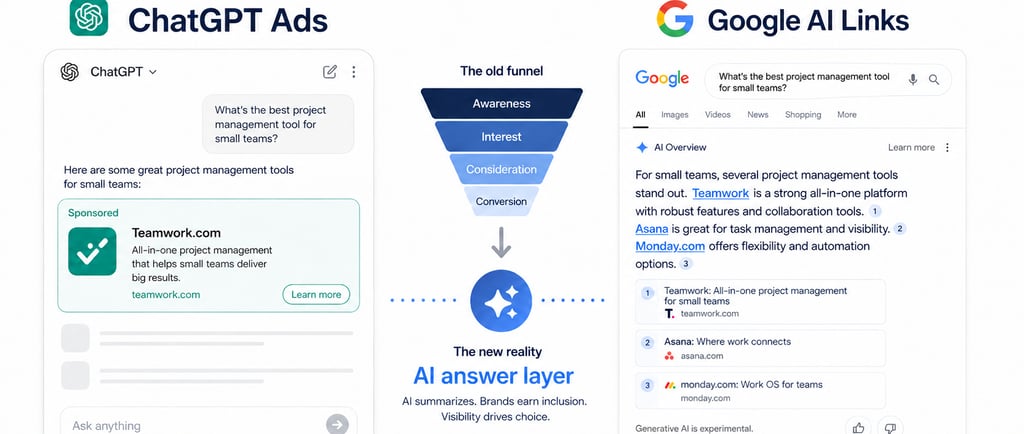
OpenAI is opening the door to ChatGPT ads, while Google is changing how links appear inside AI-powered search. For performance marketers, the real shift is not only where ads appear. It is where decisions are now being shaped.
For years, performance marketing was built around a relatively simple model.
A user searched, clicked, compared, landed on a website, and either converted or left.
That model was never perfect, but it gave marketers something clear to work with. We could optimize keywords, audiences, landing pages, bids, tracking, creative, and conversion paths. If traffic increased and conversion rates improved, the system was working.
Now that journey is becoming less linear.
Users are no longer always starting with a search result page. They are asking ChatGPT, Gemini, Perplexity, Copilot, and other AI tools for answers, comparisons, recommendations, summaries, and explanations. They may still click, but often much later in the journey, when they have already formed an opinion.
This is why the latest changes from OpenAI and Google matter.
OpenAI is moving ChatGPT closer to becoming an advertising environment. Google is adjusting how links appear inside AI-driven search experiences. On the surface, these look like two separate product updates. But for marketers, they point to the same direction.
The next performance marketing battleground is the answer layer.
What is the answer layer?
The answer layer is the space between the user’s question and the website visit.
It is where AI systems summarize options, explain topics, compare providers, recommend next steps, and decide which sources are worth showing.
In traditional search, the user saw a list of links.
In AI-driven discovery, the user sees an answer.
That answer may include brands, sources, links, product names, explanations, and recommendations. But the user is no longer forced to click through several websites to understand the basics. Much of the comparison can happen before the visit.
That changes the role of performance marketing.
The old question was:
“How do we get more people to click?”
The new question is:
“How do we become visible, useful, and trusted before the click happens?”
That is a very different challenge.
Why ChatGPT ads matter
ChatGPT ads are important because they could change how paid media appears inside a conversation.
A traditional ad interrupts a feed, appears beside a search result, or follows a user across the web. But an ad inside an AI assistant could appear much closer to the moment of intent.
The user is not just browsing.
They are asking for help.
They might be comparing software, planning a purchase, researching a service, looking for advice, or trying to make a decision. If advertising enters that environment, the quality of the offer, the clarity of the message, and the relevance of the placement become even more important.
This is not just another place to upload the same campaign assets.
If ChatGPT becomes a serious paid media channel, weak campaigns will be exposed quickly.
Generic creative will not be enough. Vague landing pages will not be enough. Poor tracking will not be enough. A campaign that only works because it gets cheap clicks may struggle in an environment where the user expects direct, useful answers.
For performance marketers, this means ChatGPT ads should not be treated as a simple media extension.
They should be treated as a new intent environment.
Why Google’s AI links matter
Google’s AI search changes matter for a different reason.
Search has always been one of the most important sources of commercial discovery. But AI Overviews and AI Mode change how users interact with information. Instead of moving immediately from query to list of links, users may now receive a generated answer with selected sources and links included inside the experience.
That means ranking is still important, but it is no longer the whole story.
The better question is not only:
“Are we ranking?”
It is also:
“Are we being included?”
In AI search, a brand can lose visibility even if it has content. A page can exist, but if it is unclear, thin, generic, poorly structured, or not useful enough to support an answer, it may not be selected as a helpful source.
This is especially important for B2B and performance marketing teams.
Many websites were built for conversion, not explanation. They tell people to book a demo, request a quote, or talk to sales, but they do not clearly explain the problem, the category, the comparison, the use case, or the buying criteria.
That was already a problem for SEO.
In the AI search era, it becomes a bigger problem.
Your website is no longer only a destination. It is also training material for how AI systems understand your company, your offer, and your relevance.
The click is becoming more expensive
This does not mean clicks disappear.
But it does mean clicks may become harder to win.
If users get more information directly inside AI tools, fewer people may click just to learn the basics. The visitors who do click may be more informed, more selective, and closer to a decision.
That sounds positive, but it creates a measurement problem.
Traffic may go down while influence goes up.
A user might discover your brand in an AI answer, compare you against competitors, read a summary of your solution, and only visit your website later through direct traffic, branded search, LinkedIn, or a retargeting ad.
In that case, your analytics may not show the full journey.
This is one of the biggest challenges for performance marketers. We are used to optimizing what we can measure. But AI-driven discovery may influence decisions in places where attribution is weaker.
That does not mean performance marketing becomes less important.
It means performance marketers need to become better at understanding signals.
What performance marketers should fix now
The first thing to fix is content clarity.
Your website should clearly explain who you help, what problem you solve, how your solution works, what makes you different, and when someone should choose you instead of another option.
This sounds basic, but many websites fail here.
They use broad language. They hide the real value behind buzzwords. They assume the visitor already understands the category. They focus on conversion before they have earned trust.
In an AI-driven environment, unclear content becomes a performance problem.
The second thing to fix is landing page quality.
If AI tools and AI-powered ads send more informed users to your site, the landing page must be ready. It should not only look good. It should answer the next question in the buyer’s mind.
What is this?
Why does it matter?
Is it for me?
Why should I trust it?
What should I do next?
The third thing to fix is measurement.
Teams should start watching more than sessions and last-click conversions. They should look at branded search, direct traffic quality, assisted conversions, engagement from high-intent pages, demo quality, lead quality, and mentions across AI tools where possible.
The fourth thing to fix is creative.
If ads start appearing in more conversational environments, creative cannot only be polished. It has to be useful. The message needs to match the user’s problem more directly. The offer needs to be specific. The next step needs to feel natural.
The fifth thing to fix is authority.
AI systems need clear signals. Humans do too.
That means expert content, original points of view, comparison pages, use-case pages, practical guides, FAQs, and consistent language across your website, LinkedIn profiles, company pages, directories, and public mentions.
This is not just SEO.
It is AI-readable authority.
The mistake marketers will make
Many marketers will treat this as another channel update.
They will ask:
“How do we advertise in ChatGPT?”
Or:
“How do we optimize for Google AI Overviews?”
Those are useful questions, but they are not enough.
The deeper question is:
“Is our marketing clear enough to be understood, trusted, and selected by AI systems and humans at the same time?”
Because that is where the market is going.
The winners will not be the teams that simply publish more AI content. They will be the teams that make their expertise easier to understand, easier to verify, and easier to act on.
More content will not solve unclear positioning.
More traffic will not fix weak landing pages.
More automation will not repair poor measurement.
AI does not remove the fundamentals of performance marketing. It puts more pressure on them.
Final thought
ChatGPT ads and Google AI links are not small updates. They are signs of a larger shift.
Performance marketing is moving away from a world where the click was the beginning of the journey.
Now, the click may come after the user has already asked, compared, filtered, and formed an opinion inside an AI experience.
That means marketers need to think beyond traffic.
They need to think about inclusion, clarity, trust, and conversion readiness.
The new performance question is not only:
“How do we get found?”
It is:
“Are we worth selecting when AI helps the buyer decide?”