
Maybe Attribution Is Not Your Real Problem
B2B attribution is no longer about finding one perfect lead source. Learn how marketers can use lead signals, CRM data, sales feedback, account activity, and AI visibility to understand what creates pipeline.
INSIGHTS
Market Ralph
6/4/20267 min read
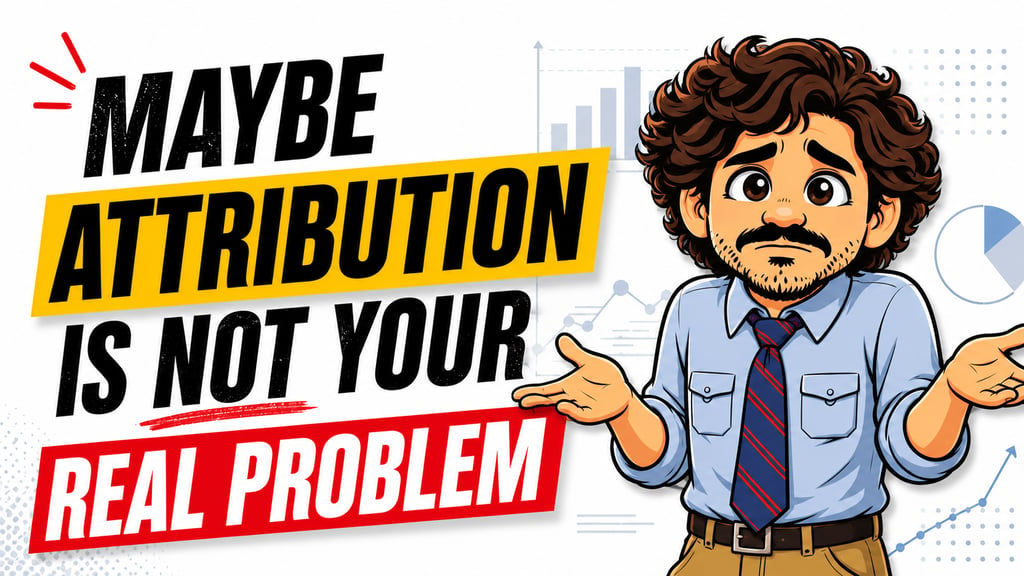
Why B2B marketers need to stop chasing one perfect lead source and start building better evidence
Every B2B marketer knows this moment.
A campaign is running. Leads are coming in. The dashboard looks active. Sales has started conversations. Then someone from leadership asks the question everyone knew was coming:
Which campaign created this opportunity?
And that is when the problem starts.
Google Ads says one thing. LinkedIn says another. GA4 shows a different version of the story. The CRM says “direct traffic.” Sales says, “I think they already knew us.” Someone checks the UTM. Someone else checks the lifecycle stage. Then the meeting turns into a debate about which system is telling the truth.
But maybe that is the wrong debate.
Maybe attribution is not the real problem.
Maybe the real problem is that most companies do not have a connected evidence system.
They have campaign data in one place. CRM data in another. Sales feedback in conversations. Website behavior in analytics. AI visibility somewhere nobody is checking. And when all of those signals stay disconnected, marketing is forced to defend performance with incomplete proof.
That is why the old question, “Where did the lead come from?”, is no longer enough.
It sounds simple. It sounds logical. It sounds like the kind of question every performance marketer should be able to answer.
But modern B2B buying is not simple.
A buyer may first see your company on LinkedIn. They do not click. A few days later, they search for the problem on Google. Then they ask ChatGPT or Perplexity for advice. Then they read one of your articles. Then they visit your website from their phone. Then they mention the problem in an internal meeting. Then someone else from the same company visits your pricing or contact page. Two weeks later, a different person fills out the form.
The CRM then reports:
Source: Direct traffic.
Technically, maybe that is true.
But strategically, it is almost useless.
Because the real question was never only where the form fill came from. The real question is:
What created enough interest, trust, and intent for this company to speak with us?
That is the question many attribution systems are not built to answer.
For years, marketers were told to look for one source of truth. One dashboard. One source field. One channel that gets the credit. One clean answer that explains the journey.
But in B2B, the journey is rarely clean.
It is slow. It is anonymous. It involves more than one person. It happens across ads, content, search, social, sales conversations, referrals, AI tools, dark social, direct traffic, and internal company discussions.
So when we try to explain that journey with one source field, we reduce a complex buying process into one label.
And that is where many teams make bad decisions.
They give too much credit to the last visible click. They cut content because it does not convert directly. They underestimate LinkedIn because it does not always show clean attribution. They ignore branded search because it appears as organic or direct. They forget that sales conversations often contain the real reason a buyer remembered the company.
Then marketing gets judged by the easiest thing to measure, not by the thing that actually influenced the opportunity.
This is how good marketing gets undervalued.
Not because it failed.
Because the evidence was not connected.
This is why B2B teams need to move from lead source tracking to lead signal tracking.
A lead source tells you where something was captured.
A lead signal helps you understand what may have influenced the opportunity before it was captured.
That difference matters.
A UTM is a signal.
A click ID is a signal.
A form submission is a signal.
A CRM source field is a signal.
A sales note is a signal.
A branded search increase is a signal.
A returning account visit is a signal.
A buyer saying “I saw your post” is a signal.
A company being mentioned by AI tools for the right problem is also a signal.
None of these signals are perfect.
But together, they tell a much better story than one lonely CRM field.
This does not mean companies should abandon tracking basics. The opposite is true. If UTMs are missing, if hidden fields do not work, if the CRM overwrites the original source, if sales does not update lifecycle stages, or if opportunities are not connected back to contacts and accounts, attribution will break very quickly.
The basics still matter.
But they are no longer enough.
The next step is to connect the evidence around the opportunity.
This is where marketing, sales, RevOps, and analytics need to work differently. Not because everyone needs more meetings. Not because marketing wants sales to fill out endless fields. But because every team holds a different part of the truth.
Marketing knows which campaigns were running.
Analytics knows what happened on the website.
RevOps knows what was captured in the CRM.
Sales knows what buyers actually said.
Leadership knows which opportunities mattered.
The problem is that these pieces often stay separate.
So the company does not really have an attribution problem.
It has a connection problem.
It has an evidence problem.
It has a signal problem.
A better system would not ask one platform to explain everything. It would look at the full pattern before an opportunity appears.
Did the account visit the website more than once? Did more than one person from the same company engage? Did branded search increase after a campaign? Did sales hear that the buyer already knew the company? Did the buyer mention LinkedIn, a guide, a webinar, a referral, a community, or an AI tool? Did the CRM capture the first touch and the last touch? Did the opportunity connect back to the original contact? Did the platform optimize toward leads, or toward qualified pipeline?
That is a much better conversation.
Because now marketing is not trying to prove everything with one broken report.
It is building a body of evidence.
This is also where AI visibility becomes important.
Buyers are no longer only using Google to discover solutions. They are asking AI tools to explain problems, compare options, suggest vendors, summarize categories, and recommend what to do next.
If someone asks an AI tool about the problem your company solves, does your brand appear?
Does the answer understand what you do?
Does it mention your competitors but not you?
Does it connect your company with the right category?
Does your content give AI systems enough clear information to understand your expertise?
This may not look like classic attribution. But it is becoming part of the discovery journey. If AI tools influence how buyers understand a market, then AI visibility becomes another signal marketers need to track.
Again, not as perfect proof.
As evidence.
That is the main shift.
Modern B2B attribution should not pretend to deliver perfect certainty. It should help teams collect enough connected evidence to make better decisions.
If a campaign generates many leads but sales rejects most of them, that is evidence.
If a piece of content gets mentioned repeatedly in sales calls, that is evidence.
If direct traffic increases after a strong LinkedIn campaign, that is evidence.
If branded search grows after a thought leadership push, that is evidence.
If an account returns several times before one person converts, that is evidence.
If AI tools consistently ignore your company when answering questions about your category, that is evidence too.
The smartest marketers will not be the ones who believe every dashboard.
They will be the ones who know how to read the signals.
This does not make marketing easier. In some ways, it makes it harder. It requires more discipline. Cleaner CRM fields. Better sales feedback. Better content. Better analytics. Better connection between teams.
But it also makes marketing more honest.
Because the truth is that many buyer journeys will never be fully visible.
Some people will not fill out forms. Some will reject cookies. Some will research anonymously. Some will come through referrals. Some will ask AI tools. Some will see your content many times before ever clicking. Some will speak to sales after months of invisible influence.
Trying to force all of that into one source field is not measurement.
It is oversimplification.
The future of B2B attribution is not one perfect answer.
It is a stronger evidence system.
Not one source.
Many signals.
Better decisions.
That is the mindset marketers need now.
Because the companies that keep asking only “Where did the lead come from?” will keep arguing about dashboards.
The companies that ask “What signals appeared before this became pipeline?” will understand the buyer journey much better.
And that is where performance marketing needs to go next.
Questions this article answers
What is wrong with traditional B2B attribution?
Traditional B2B attribution often relies too heavily on one lead source, one last click, or one CRM field. This can miss the real buying journey, especially when buyers research anonymously, use multiple devices, involve several people, or discover companies through content, social media, referrals, sales conversations, or AI tools.
Is lead source tracking still useful?
Yes. Lead source tracking is still useful, but it should not be treated as the full truth. UTMs, click IDs, hidden form fields, CRM source fields, and lifecycle stages are still important. The problem is relying on them alone to explain a complex B2B buying process.
What is lead signal tracking?
Lead signal tracking is the practice of collecting multiple pieces of evidence around a lead, account, or opportunity. These signals can include campaign clicks, CRM data, website behavior, sales feedback, branded search, self-reported attribution, account activity, and AI visibility.
Why does CRM data often break attribution?
CRM data breaks attribution when source fields are missing, overwritten, incomplete, or not connected to opportunities. Attribution also weakens when sales does not update lifecycle stages, rejection reasons, or opportunity data.
How can B2B marketers improve attribution?
B2B marketers can improve attribution by capturing campaign data properly, protecting original source fields, connecting leads to opportunities, collecting sales feedback, asking buyers how they heard about the company, tracking account-level activity, and monitoring AI visibility.
Why is AI visibility important for attribution?
AI visibility matters because buyers increasingly use tools like ChatGPT, Perplexity, Gemini, and AI-powered search to research problems, compare solutions, and understand vendors. If AI tools mention or ignore a company, that can influence demand before a visitor ever reaches the website.