
AI Marketing Has a Data Problem: Why Better Signals Matter More Than More Tools
AI marketing depends on clean data, connected signals, and better measurement. Publicis buying LiveRamp shows why data quality now matters more than tools.
INSIGHTS
Rafael Echavarria
5/19/20267 min read
AI is changing marketing, but not in the way many teams think. The real advantage will not come from using more AI tools. It will come from giving AI better data, cleaner signals, and clearer business context.
Most marketing conversations about AI still start in the same place: tools.
Which AI tool can write better ads? Which one can create better images? Which one can automate reports, summarize meetings, generate landing pages, build audiences, or launch campaigns faster?
These are useful questions, but they are not the most important ones. They focus on what AI can produce, not on what AI understands.
That distinction matters.
AI does not become valuable in marketing just because it can generate more content, more creative, or more campaign variations. It becomes valuable when it can make better decisions, support better strategy, and help teams understand what is actually working.
And that depends on data.
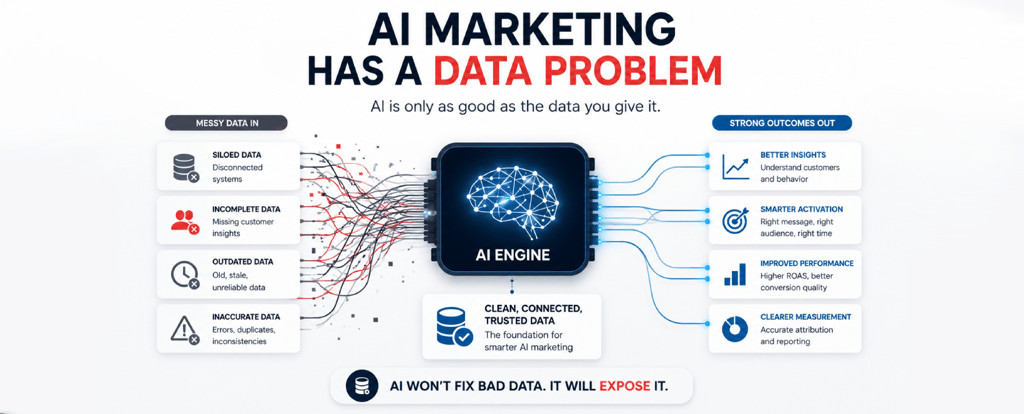
If the data is weak, fragmented, outdated, or disconnected from real business outcomes, AI does not magically fix the problem. It usually makes the problem bigger, faster, and harder to see.
That is why Publicis’ plan to acquire LiveRamp is more than an agency story. Publicis announced an all-cash agreement to acquire LiveRamp for an enterprise value of about $2.17 billion, describing the move as a way to accelerate data co-creation for smarter agents. LiveRamp also says the transaction has been unanimously approved by both companies’ boards.
The interesting part is not only the size of the deal. It is the direction of travel.
One of the world’s largest agency groups is not simply buying another creative shop, media network, or content production tool. It is buying deeper data collaboration capability. That says something important about where AI marketing is going.
The next phase of AI marketing will not be won by the teams that generate the most content. It will be won by the teams that connect the best signals.
AI does not remove the need for good marketing foundations
There is a dangerous belief forming around AI in marketing: that better tools will compensate for weak fundamentals.
They will not.
If a company has poor conversion tracking, AI can optimize toward the wrong outcomes with more confidence. If the CRM is messy, AI can misunderstand lead quality. If sales feedback is inconsistent, AI can mistake volume for value. If landing pages are vague, AI systems may struggle to understand what the company should be associated with. If reporting is disconnected, AI may give teams faster answers, but not necessarily better ones.
This is the uncomfortable part of AI marketing. The technology can look impressive on the surface while still being guided by poor inputs underneath.
For years, performance marketing teams have managed growth through a collection of disconnected systems: Google Ads, Meta, LinkedIn, retargeting platforms, landing pages, analytics dashboards, CRM data, and sales reports. Each platform has its own metrics, its own optimization logic, and often its own version of the truth.
That was already difficult before AI.
Now it matters even more.
When AI systems begin making more decisions about audiences, creative, bidding, content, recommendations, and customer journeys, the quality of the input becomes a competitive advantage. The question is no longer only whether a marketing team uses AI. Almost everyone will. The better question is whether the AI is being guided by signals that actually reflect the business.
A lead is not always a good lead. A click is not always useful intent. A conversion is not always revenue. A high engagement rate does not always mean stronger demand.
AI can help marketers move faster, but speed without signal is just automation with better design.
The real AI marketing advantage is connected data
The companies that benefit most from AI will probably not be the ones with the biggest prompt libraries or the most automated content workflows. They will be the companies that can connect customer behavior, campaign performance, sales outcomes, product information, content clarity, and first-party data into something AI can actually use.
That is why data collaboration, identity, clean rooms, CRM hygiene, conversion quality, and measurement discipline are becoming important again.
They may not sound as exciting as AI agents or generative creative, but they are the foundation those systems depend on.
Publicis’ LiveRamp move points in that direction. LiveRamp describes itself as a data collaboration platform that helps companies connect data across partners and environments while protecting privacy. Reuters reported that LiveRamp links more than 25,000 publisher domains and over 500 partners, which helps explain why this type of infrastructure matters in an AI-driven marketing environment.
This is where many marketing teams need to slow down.
The temptation is to ask, “What can we automate next?”
A better question is, “What are we feeding into the automation?”
Because if the input is incomplete, the output may still look polished. That is the risk. AI can create a beautiful campaign from a weak strategy. It can summarize bad data in a confident way. It can generate more landing page copy without fixing the positioning. It can produce more reports without solving the measurement problem.
In other words, AI can make weak marketing look more advanced than it really is.
Measurement will become harder, not easier
Performance marketing has always depended on measurement, but the old measurement model is under pressure.
Cookies weakened. Privacy rules became stricter. Platform reporting became more modeled. User journeys became less linear. Buyers started moving across more touchpoints before converting.
AI adds another layer to this problem.
A potential customer may ask ChatGPT for advice, see a Google AI Overview, compare vendors inside an AI-generated answer, read a few LinkedIn comments, visit a website days later through branded search, and eventually convert through direct traffic.
Which channel gets the credit?
Probably not the one that shaped the decision.
This is a serious problem for marketing teams, because the activity that influences demand may become harder to measure, while the activity that captures demand may look stronger in analytics.
That can lead to bad decisions.
A team might reduce investment in content, thought leadership, organic visibility, community, or category education because those activities do not show direct conversions. At the same time, they may overvalue bottom-of-funnel channels because those channels appear closer to the conversion.
This is not new, but AI makes the gap wider.
Performance marketers will need to become better at reading indirect signals. Branded search, direct traffic quality, assisted conversions, returning visitors, high-intent page engagement, sales feedback, pipeline progression, and lead quality will all matter more. The goal is not to abandon attribution, but to stop pretending that one report can explain the full buyer journey.
AI does not make measurement discipline less important.
It makes it more important.
Your website is now part of the data layer
One of the biggest shifts in marketing is that the website is no longer only a destination.
It is also a source of truth.
AI systems use public information to understand what a company does, who it serves, how it is described, what problems it solves, and whether it deserves to be included in an answer. That means unclear website content is not just a branding issue. It can become a visibility issue, a performance issue, and eventually a revenue issue.
If your website uses vague language, AI tools may struggle to classify you properly. If your category language changes from page to page, your positioning becomes harder to understand. If your content says the same thing as everyone else, there is little reason for AI systems or buyers to treat it as useful. If your pages do not answer real buyer questions, another source may be selected instead.
This is where SEO, content, brand, and performance marketing start to overlap.
A landing page can no longer be judged only by whether it looks good or has a clear button. It also needs to explain the problem, the use case, the audience, the value, the proof, and the next step. It needs to help both humans and machines understand why the company matters.
Google has also made it clear that its spam policies apply to generative AI responses in Search, including attempts to manipulate those responses. That is a useful reminder that AI visibility will not be a free-for-all where brands can simply produce large volumes of low-quality content and expect to be rewarded.
The answer is not to publish more generic AI-written pages.
The answer is to become easier to understand, easier to trust, and easier to verify.
What marketers should fix before adding more AI
The practical response is not to stop using AI. That would make no sense. AI is already becoming part of the marketing workflow, and teams that ignore it will fall behind.
But the order matters.
Before adding more AI tools, marketers should look at the quality of the signals those tools will depend on.
Start with tracking. Are you measuring the actions that actually matter to the business, or only the actions that are easiest to capture? A form fill, a download, or a low-quality lead may not be a meaningful signal if it does not connect to revenue or pipeline quality.
Then look at CRM data. If lead stages are inconsistent, source fields are messy, or sales feedback is missing, AI will not magically understand which campaigns are creating value. It will learn from the same confusion the team is already working with.
Then review website clarity. Can someone understand in a few seconds who the company helps, what problem it solves, and why it is different? Can an AI system extract the same meaning from the content? If not, the issue is not only copywriting. It is market communication.
Then review campaign optimization. Are platforms being trained on meaningful conversions, or are they being rewarded for cheap activity? AI-powered campaigns can only optimize toward the goals they are given.
Finally, review reporting. If each channel has a separate dashboard and a separate definition of success, the business may be optimizing fragments instead of outcomes.
This is the less glamorous side of AI marketing, but it is where the real advantage will come from.
The mistake will be confusing speed with intelligence
The most common AI marketing mistake will be assuming that faster output means better marketing.
It does not.
Faster content is not better content. Faster reporting is not better insight. Faster campaign creation is not better strategy. Faster testing is not better learning if the test is based on weak assumptions.
AI can help a good marketing system become more effective. But it can also help a weak marketing system produce more noise.
That is why the question “How do we use more AI?” is not enough.
The better question is:
What do we need to fix so AI can actually help?
That question is slower. It is less exciting. It does not sound like a growth hack. But it is the question marketing leaders should be asking now.
Because the future of AI marketing will not only depend on the model. It will depend on the quality of the business context around the model.
Final thought
Publicis buying LiveRamp is not just a story about agencies, data platforms, or M&A.
It is a signal.
The next stage of marketing will require more than AI-generated content, automated campaigns, and faster creative production. It will require cleaner data, better-connected systems, stronger measurement, clearer positioning, and more reliable signals.
AI will not fix weak marketing data.
It will expose it.
And that may be the most important lesson for performance marketers right now.